- Tightening of Permanent Residence Permission Examinations in Japan
- What Is the Tightening of Permanent Residence Permission Examinations?
- When Do the Stricter Rules Apply? Quick Reference by Application Date
- Differences from the Fee Revision and the Permanent Residence Revocation System
- What Has Changed? Old and New Permanent Residence Guidelines Compared
- Income | Comparing Household Annual Income with the Average for Japanese Households
- Pension | Expected Future Pension Benefits
- Japanese-Language Proficiency, Understanding of Systems, and Children’s School Attendance
- How Taxes, Social Insurance, Notification Obligations, and Criminal Penalties Are Considered
- Impact According to Applicant Type
- Preparations for Prospective Permanent Residence Applicants
- Illustrative Preparation Scenarios
- Frequently Asked Questions
- Q: How Much Annual Income Do I Need to Obtain Permanent Residence?
- Q: Which Examination Should I Take to Prove Japanese-Language Proficiency Equivalent to B1?
- Q: If My Application Is Refused, Can I File an Administrative Appeal?
- Q: I Already Hold Permanent Resident Status. Could This Revision Cause Me to Lose It?
- Q: I Heard Naturalization Examinations Have Also Become Stricter. How Is That Different from Permanent Residence?
- Conclusion
Tightening of Permanent Residence Permission Examinations in Japan
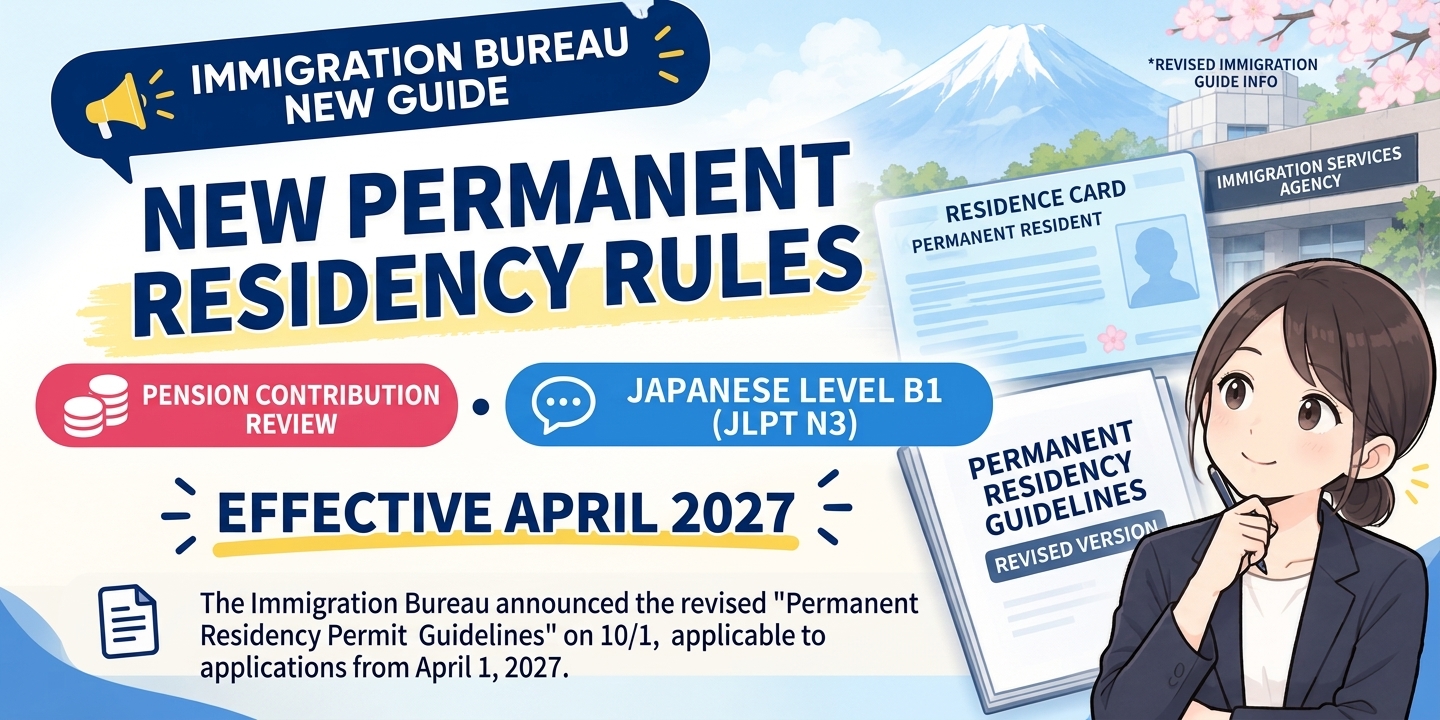
The “Guidelines on Permission for Permanent Residence,” which set out how applications for permanent residence are examined, were revised on October 1, 2026 (Reiwa 8).
Factors such as household annual income levels, future pension entitlements, and Japanese-language proficiency are now expressly identified as matters for consideration. In addition, the periods required under the special provisions for spouses of Japanese nationals, Permanent Residents, and Special Permanent Residents will be extended for applications submitted on or after April 1, 2027.
The revised guidelines will apply in full to applications filed on or after April 1, 2027 (Reiwa 9).
However, the income-related provisions have applied from October 1, 2026 to applications filed on or after April 1 of that year, including those still under examination as of October 1.
The standards applied depend on the date the application was filed.
Based on information published by the Immigration Services Agency of Japan (hereinafter the “ISA”), this article explains when the tighter examination of permanent residence permission begins, what has changed, and who will be affected and how.
The expression “permanent residence rights,” commonly used in Japanese, refers to the status of residence “Permanent Resident.” The permission granted to acquire that status is called “permission for permanent residence.”
What Is the Tightening of Permanent Residence Permission Examinations?
The tightening of permanent residence permission examinations refers to the revision of examination standards under the October 1, 2026 amendment to the Guidelines on Permission for Permanent Residence.
The revised guidelines expressly state that “particularly careful examination is necessary” when deciding whether to grant permanent residence, and clarify or add factors to be considered.
Let us first review the history of the revision and its relationship to the statutory requirements.
Background to the Revision
On January 23, 2026, the government adopted and published the “Comprehensive Measures for Acceptance of Foreign Nationals and Orderly Coexistence.”
The present revision follows the recommendation in those measures that the arrangements for granting permanent residence should be reviewed.
A proposed revision was published on August 4, 2026, followed by a public comment period ending on September 3.
A total of 5,180 submissions were received. The proposed text was not changed in response to the submitted comments, and the revision took effect on October 1.
The Framework of Three Statutory Requirements Remains Unchanged
The requirements for permission for permanent residence are the three requirements specified in Article 22, paragraph (2) of the Immigration Control and Refugee Recognition Act (hereinafter the “Immigration Control Act”): good conduct, independent livelihood, and conformity with Japan’s interests.
Spouses or children of Japanese nationals, Permanent Residents, or Special Permanent Residents are not required to satisfy the good conduct and independent livelihood requirements.
However, the way the requirements are interpreted has been set out in greater detail.
For the independent livelihood requirement, applicants are expected to have “economic circumstances at least equivalent to those of Japanese nationals.” Under the national interest requirement, applicants are expected not merely to avoid acting against Japan’s interests, but to bring positive and concrete benefits to Japan. Both provisions apply to applications filed on or after April 1, 2027.
When Do the Stricter Rules Apply? Quick Reference by Application Date
Whether and when the new standards affect you depends not on the date of the revision, but on the date on which you applied for permanent residence.
On October 1, 2026, the ISA announced which version of the guidelines would apply to applications filed during different periods.
First, identify which category your application date falls into.
| Date permanent residence application was filed | Applicable guidelines |
|---|---|
| By March 31, 2026 | Version revised on February 24, 2026 (Reiwa 8) |
| April 1, 2026–March 31, 2027 (including prospective applicants) | Version revised on February 24, 2026, except that only the income-related provisions (Part 2, 4(2) and Part 2, 5(7)) are governed by the October 1, 2026 version |
| April 1, 2027 or later | Version revised on October 1, 2026 |
The same notice also states that the “Guidelines on Permission for Permanent Residence for Persons Recognized as Having Contributed to Japan” will be abolished as of March 31, 2027.
Applicants Filing Between April 1, 2026 and March 31, 2027
For applications filed during this period, including those to be filed, only the income criteria (Part 2, 4(2)) and the requirement that the applicant “not become a public burden” (Part 2, 5(7)) are examined under the revised guidelines.
This also includes applications filed between April and September 2026 that remained under examination as of October 1.
The newly considered amount of pension expected to be received, Japanese-language proficiency, and extended residence periods under the spousal exceptions do not apply to applications filed during this period.
Payment history for public pension premiums has, however, long been part of the examination.
At an August 4 press conference announcing the proposed revision, the Minister of Justice explained that the income provisions would begin to apply from the revision date of October 1.
The reason given was that income is important for determining whether an applicant can support themselves, and continuing the previous practice after the revision would not be appropriate.
The decision to cover applications filed within the six months before the revision date reportedly took into account the standard processing period for permanent residence applications, which is four to six months.
Treatment of a “Three-Year” Period of Stay and Transitional Measures After April 2027
To obtain permanent residence permission, an applicant must be residing in Japan with the “longest period of stay” available under their current status of residence.
For example, the longest period of stay under “Spouse or Child of Japanese National” and “Engineer/Specialist in Humanities/International Services” is five years.
Note 4 of the revised guidelines states that for applications filed by March 31, 2027, a “three-year” period of stay will also be treated as the longest period.
For applications filed on or after April 1, 2027, a three-year period will be considered the longest only if all of the following conditions are met:
- The applicant holds a three-year period of stay as of March 31, 2027.
- It is the applicant’s first permanent residence application filed on or after April 1, 2027.
- A decision (disposition) is issued between April 1, 2027 and the expiration date of that three-year period of stay.
However, Note 1 of the previous guidelines, which apply to applications filed by March 31, 2027, also contains transitional arrangements, and those provisions are worded by reference to the date of the disposition.
Applicants who expect a decision in or after April 2027, or who need to extend their period of stay while their permanent residence application is under examination, should not rely solely on the application date; they should confirm the handling with the ISA.
Differences from the Fee Revision and the Permanent Residence Revocation System
Three changes to systems relating to permanent residence overlap during 2026 and 2027.
They are all sometimes described in news reports as a “tightening of permanent residence,” but they have different start dates and affect different people.
The following table distinguishes them.
| System change | Main content | Effective date | People affected |
|---|---|---|---|
| Revision of permanent residence permission guidelines (this article) | Clarification and addition of factors considered in examinations | Applied in stages from October 1, 2026 (according to the filing date) | Prospective applicants and those whose applications filed on or after April 1, 2026 remain under examination |
| Revision of residence permission fees | Permanent residence permission fee increases from ¥10,000 to ¥200,000 | Applications accepted on or after October 1, 2026 | Persons granted permanent residence permission |
| Additional grounds for revoking Permanent Resident status | Intentional nonpayment of public taxes and charges and other matters added as grounds for revocation | Effective April 1, 2027 | Holders of Permanent Resident status (including persons granted that status in the future) |
The system for revoking a status of residence has existed for some time; new grounds specifically concerning permanent residents will be added on April 1, 2027.
On October 1, 2026, the ISA also adopted the “Guidelines on Revocation of the Status of Residence ‘Permanent Resident’.”
What Has Changed? Old and New Permanent Residence Guidelines Compared
The revision substantially expands the factors considered in examining the independent livelihood and national interest requirements.
The following table compares the main differences between the previous version (revised February 24, 2026) and the new version (revised October 1, 2026).
The references in parentheses are item numbers from the revised guidelines.
| Item | Before revision | After revision | Applications affected |
|---|---|---|---|
| Income (Part 2, 4(2)) | No reliance on public support and a reasonable prospect of stable future life | Whether household annual income has continuously reached a level above the average income of Japanese households of the same size | Filed from April 1, 2026 |
| Public burden (Part 2, 5(7)) | Not listed separately under the national interest requirement | Whether the household, including spouses and others, is not a public burden | Filed from April 1, 2026 |
| Pension (Part 2, 4(3)) | No reference to projected pension benefits (payment of pension premiums was listed as a public obligation) | Projected amount of future pension benefits | Filed from April 1, 2027 |
| Japanese-language proficiency (Part 2, 5(8)) | Not specified | Equivalent to B1 or higher (with certain exclusions) | Filed from April 1, 2027 |
| Understanding of systems and rules (Part 2, 5(9)) | Not specified | Primarily assessed against the content of the “Guidebook on Living and Working” | Filed from April 1, 2027 |
| School attendance of school-age children (Part 2, 5(10)) | Not specified | Whether children attend elementary or junior high school | Filed from April 1, 2027 |
| Taxes and social insurance premiums (Part 2, 5(3)) | Failure to pay by the due date generally assessed negatively | In addition to improper payment, having been subject to delinquency collection measures in the past is generally assessed negatively; usually examined at household level | Filed from April 1, 2027 |
| Periods spent outside Japan (Part 2, 5(6)) | Not specified | Absence without a reasonable reason, within the preceding ten years, for six months or more on one occasion or two years and six months or more in total is generally assessed negatively | Filed from April 1, 2027 |
| Contribution to government measures (Part 2, 5(11)) | Not specified | Consideration also given to contributions to promoting the Special Residence Card and creating opportunities for studying Japanese and understanding relevant systems | Filed from April 1, 2027 |
| Work statuses counted toward “five years or more” (Note 2) | Excludes Technical Intern Training and Specified Skilled Worker (i) | Excludes Technical Intern Training, Employment for Skill Development, Specified Skilled Worker (i), Intra-company Transferee, and certain Designated Activities | Filed from April 1, 2027 |
| Designated Activities counted toward “ten years” (Part 5) | Not specified | Periods of exceptional or temporary Designated Activities, such as continued job hunting or job offer holders, do not count toward ten years | Filed from April 1, 2027 |
| Special provisions for spouses (Part 3, 1) | Genuine marriage continuing for at least three years, and continuous residence for at least one year (biological children and others: continuous residence for at least one year) | Genuine marriage continuing for at least five years, and continuous residence for at least three years (biological children and others: continuous residence for at least three years) | Filed from April 1, 2027 |
| Persons excluded from special provisions (Note 5) | Not specified | Residence-period exceptions do not apply to persons granted Special Permission to Stay or Special Permission to Land (the latter limited to persons subject to grounds for denial of landing) | Filed from April 1, 2027 |
Items marked “filed from April 1, 2026” have applied from October 1, 2026 to applications filed on or after April 1 of that year (including those pending on October 1) and subsequent applications.
(Source: ISA, “Guidelines on Permission for Permanent Residence” (revised October 1, 2026); same guidelines (revised February 24, 2026))
Income | Comparing Household Annual Income with the Average for Japanese Households
The income criteria are the part of the new rules that began applying in advance from October 1, 2026 to applications filed on or after April 1 of that year.
In principle, the examination considers whether, at the time of application, the annual income of the applicant’s household has continuously reached a level “exceeding the average income of Japanese households according to the number of household members” (the income threshold).
Examinations are generally conducted on the basis of a household sharing the same livelihood. The following rules govern the calculation of household annual income:
- For a single-person household, the applicant’s own annual income is the household annual income.
- Income earned by family members holding statuses such as “Dependent,” who can work only exceptionally and within limits under permission to engage in activities outside their status of residence, is not combined with other household income.
- For a person who is no longer supported by their parents, for example because they have reached adulthood, the parents’ income is not included.
- Supported family members are counted in household size even if they live abroad and do not live with the applicant.
- When a household has five or more members, the additional cost of living and similar expenses is added to the income threshold.
The guidelines give no specific monetary amounts and do not specify how long the income threshold must have been met “continuously.”
In the results of the public comment process published on October 1, 2026, the ISA stated that it did not plan to disclose the specific income threshold, expected pension threshold, or amount of compensating assets, from the standpoint of maintaining the effectiveness of the examination and other considerations.
Some internet sources publish estimated figures based on statistics, but these are not official thresholds stated by the ISA.
Pension | Expected Future Pension Benefits
For applications filed on or after April 1, 2027, the projected amount of future pension benefits will also be considered.
The comparison benchmark is the pension that a person would be expected to receive after working for thirty years at an income meeting the annual income threshold, while being enrolled in Employees’ Pension Insurance during that period.
Even if the projected benefit falls short, applicants can be treated as meeting the standard if they have financial assets capable of making up the shortfall (“compensating assets”).
The compensating-asset threshold depends on age at application and is lower for younger applicants.
Where the applicant has a spouse, the couple’s projected pension benefits are combined. The comparison benchmark is also increased by the pension that the spouse would be expected to receive if they had been a Category 3 insured person under the National Pension system for the same period.
The compensating-asset threshold is increased in the same way.
Japanese-Language Proficiency, Understanding of Systems, and Children’s School Attendance
For applications filed from April 1, 2027, three additional matters will be considered when determining whether applicants can adapt smoothly to their local communities:
- Japanese-language proficiency: At least the equivalent of B1 under the “Framework of Reference for Japanese Language Education.” However, exclusions include highly skilled foreign professionals and their families; people who have completed a cumulative total of six years or more of elementary and secondary education under the School Education Act; and certain children of Permanent Residents born in Japan and raised by parents with Japanese proficiency equivalent to B1 or above.
- Understanding of systems and rules: Assessed through a method designated by the Commissioner of the ISA, focusing on matters covered in the ISA’s “Guidebook on Living and Working.”
- School attendance of school-age children: Whether children of compulsory-school age attend elementary or junior high school (or whether the applicant attends school, if the applicant is themselves of school age).
The guidelines do not identify which examinations will be used to assess B1 equivalence or the precise method for checking knowledge of systems and rules.
The public comment results state that the assessment methods and examinations for Japanese proficiency will be considered and announced before the April 2027 start of operation, and that methods for checking knowledge of systems and rules will also be considered before operations begin.
How Taxes, Social Insurance, Notification Obligations, and Criminal Penalties Are Considered
Descriptions of public obligations and violations of criminal laws under the national interest requirement have also become more specific.
- Taxes and social insurance premiums: Even where no amounts are outstanding at the time of application, past circumstances such as having been subject to delinquency collection measures or otherwise failing to pay appropriately will generally be assessed negatively. Examination is generally conducted at household level.
- Obligations under the Immigration Control Act: If past violations are identified, including failures to notify residential addresses or carry residence cards, they will generally be assessed negatively.
- Violations of criminal laws: Applicants sentenced to imprisonment (including the former punishments of penal servitude or imprisonment without labor), fines, or certain protective dispositions under the Juvenile Act listed in the guidelines will generally be assessed negatively.
Impact According to Applicant Type
The impact of stricter permanent residence examination differs according to current status of residence and family composition.
The following sections outline important points for four common types of applicants.
Start with the category most relevant to you.
The revised guidelines also state that persons granted Special Permission to Stay or Special Permission to Land (the latter limited to persons subject to grounds for denial of landing) cannot use exceptions to residence-period requirements for spouses, Long-Term Residents, highly skilled professionals, and others. Instead, they are generally required to reside continuously in Japan for at least ten years after such permission. This applies to applications filed on or after April 1, 2027.
Spouses of Japanese Nationals, Permanent Residents, or Special Permanent Residents
Under the law, spouses are not required to satisfy the independent livelihood requirement.
However, the revised guidelines state that a negative assessment may be made where the household is currently a public burden, or there is a real risk that it will become one, and no exceptional circumstances can be recognized as having caused that situation.
This provision applies to applications filed on or after April 1, 2026, and the decision is made comprehensively, emphasizing stable residence for the family as a unit and humanitarian considerations.
For applications filed on or after April 1, 2027, the residence-period exception requires a genuine marital relationship continuing for at least five years and continuous residence in Japan for at least three years.
Holders of Work-Related Statuses (E/S/H/IS, Business Manager, etc.)
Applicants holding “Engineer/Specialist in Humanities/International Services,” “Business Manager,” or similar statuses must generally have resided continuously in Japan for at least ten years, including at least five continuous years with a work-related or residence-related status.
For applications filed from April 1, 2026, household income is considered. For applications filed on or after April 1, 2027, expected pension benefits and Japanese-language proficiency are also considered.
The range of work-related statuses that count toward the “five years or more” requirement also changes from April 1, 2027.
The revised guidelines exclude “Employment for Skill Development,” “Intra-company Transferee,” and some forms of “Designated Activities” from qualifying work-related statuses.
People currently residing, or who previously resided, in Japan as Intra-company Transferees are advised to check individually how their residence history will be counted.
Part 5 of the revised guidelines also states that periods of certain “Designated Activities” do not count toward either the five-year work-status requirement or the generally required ten-year residence period.
Examples include continuing job hunting, holding a job offer, and business-startup activities by graduates of Japanese universities and similar institutions.
The name “Designated Activities” alone is therefore not enough; the specific designated activities and the applicant’s residence history must be checked.
Highly Skilled Professionals (70 or 80 Points)
The residence-period exceptions based on points for highly skilled professionals remain in force under the revised guidelines.
A person with 70 or more points must maintain the required score and reside continuously in Japan for at least three years. A person with 80 or more points must reside for at least one year, in addition to other conditions.
A person who has not been residing under Highly Skilled Professional status but wishes to rely on the points system must also show that they met the necessary score three years before filing (one year for those with 80 or more points) and continued to meet it afterwards.
Please note that merely reaching the required score on the application date is not sufficient. (Those meeting the criteria for Special Highly Skilled Professionals must satisfy requirements such as at least one year of continuous residence.)
Highly skilled foreign professionals and their family members are excluded from the new Japanese-language proficiency consideration.
However, the guidelines do not state that highly skilled professionals are excluded from consideration of income (for applications filed from April 1, 2026) or projected pension benefits (for applications filed from April 1, 2027).
Long-Term Residents and Dependents
The exception for persons who have resided continuously in Japan for five years or more under “Long-Term Resident” status remains unchanged.
Meanwhile, the revised guidelines expressly state that income earned by family members holding “Dependent” status is not combined with household annual income, because such income can be earned only exceptionally and within limits under permission to engage in activities outside their status. This applies to applications filed from April 1, 2026.
People who planned to count a spouse’s part-time earnings toward household income should take particular care.
Preparations for Prospective Permanent Residence Applicants
Even after the guidelines were revised, decisions to grant permanent residence remain subject to the broad discretion of the Minister of Justice.
Checking the following points before deciding when to apply can help identify gaps in preparation.
- Check the applicable filing-date category: Use the quick-reference table to confirm which guidelines apply to your application date.
- Prepare evidence of household income: Use tax assessment certificates and other documents to check changes in income over several years.
- Check tax, pension, and health insurance payments: Check timely payment and any previous delinquency collection measures, including those relating to household members.
- Check periods of stay and expiration dates: Those holding a three-year period should determine whether the three transitional conditions apply. If your existing period of stay expires while the permanent residence application is under examination, you must apply separately for an extension of that period.
- Organize departure records: Summarize the durations and reasons for travel outside Japan over the previous ten years.
- Use the ISA’s checklists: The permanent residence application page provides checklists for different statuses of residence.
We recommend deciding whether to apply while the previous guidelines remain applicable based on whether you already satisfy the requirements.
If an application is refused and a new application is filed on or after April 1, 2027, the revised guidelines will apply.
Illustrative Preparation Scenarios
These hypothetical scenarios explain issues to check. They are not client cases or reports of approvals.
Scenario 1: Frequent or Lengthy Travel Outside Japan
Organize travel dates, employment records and documents explaining why overseas trips were necessary. The assessment depends on the full residence history and applicable guidelines.
Scenario 2: A Long Marriage but a Short Residence History
Check marriage and residence periods separately, using the rules applicable on the application date. A long marriage alone does not establish eligibility.
Scenario 3: Missing National Pension Payment Records
Confirm which official payment records are available and explain any missing evidence. An explanation does not automatically replace required payment records.
Scenario 4: A Past Arrest or Other Incident
Distinguish an arrest from a conviction and accurately document the disposition and subsequent circumstances. Seek individual advice; no approval outcome is implied.
Frequently Asked Questions
Below are answers to common questions about the stricter examination of permanent residence.
The focus is on points that are particularly easy to misunderstand immediately after the revision.
Q: How Much Annual Income Do I Need to Obtain Permanent Residence?
The guidelines do not specify an amount, and the ISA states that it does not intend to publish specific figures.
The threshold differs according to household size, and exceeding a particular annual income does not automatically result in permission.
Income continuity, payment history, and other circumstances are assessed comprehensively.
Q: Which Examination Should I Take to Prove Japanese-Language Proficiency Equivalent to B1?
As of October 2026, the guidelines do not identify the examinations or qualifications to be used.
The ISA states that it will consider and announce assessment methods and tests before the new practice begins in April 2027.
Japanese-language proficiency will be considered only for applications filed on or after April 1, 2027.
Q: If My Application Is Refused, Can I File an Administrative Appeal?
The ISA’s procedural guidance lists “none” as the method of administrative appeal for permanent residence applications.
However, this does not necessarily rule out the possibility of filing a lawsuit asking a court to revoke the disposition (an action for revocation).
Litigation is subject to time limits, so consult an attorney if you wish to challenge a refusal.
If you apply again on or after April 1, 2027, the revised guidelines will govern the new application.
Q: I Already Hold Permanent Resident Status. Could This Revision Cause Me to Lose It?
These guidelines explain the examination approach used when deciding applications for permanent residence permission.
The system for revoking status of residence already exists, but from April 1, 2027, new grounds for revoking Permanent Resident status will be added, including intentional failure to pay public taxes and charges.
That is a separate change from the revision of the guidelines discussed here.
Q: I Heard Naturalization Examinations Have Also Become Stricter. How Is That Different from Permanent Residence?
Naturalization is a separate procedure under the Nationality Act. Since April 1, 2026, examination practices have been revised to include, among other things, a general requirement of at least ten years’ residence when assessing assimilation into Japanese society.
Conclusion
The tightening of permanent residence permission examinations results from the October 1, 2026 revision of the Guidelines on Permission for Permanent Residence.
Application depends on the filing date: from October 1, 2026, income criteria apply to applications filed from April 1 of that year, and the entire revised guidelines apply to applications filed on or after April 1, 2027.
- Household annual income is compared with the average income of Japanese households according to household size.
- For applications from April 1, 2027, projected pension benefits, Japanese-language proficiency, understanding of systems, and children’s school attendance are added as considerations.
- The exception for spouses of Japanese nationals and similar persons is extended to require genuine married life for at least five years and continuous residence in Japan for at least three years.
The specific income threshold and other figures are not expected to be published, and the method for confirming Japanese-language proficiency is scheduled to be announced before the start of operation in April 2027.
Please check the latest ISA information before applying.
For individual matters, including which standards apply to your filing date, consultation with a professional is recommended.
This article is based on immigration laws and regulations and publicly available information as of October 2026. Its contents may change following legal amendments or other developments. For the latest information, please check the official website of the Immigration Services Agency and other official sources. For individual cases, consultation with administrative scriveners and other professionals is recommended.
Need guidance on your own situation?
Requirements and supporting documents depend on individual circumstances. Contact Akatsuki Immigration Office to discuss your case.
Visa Worries? Let's Talk Now.
070-8971-0608