- Japan Tightens Permanent Residency Review Guidelines from April 2027
- Income Requirement: Household Income Must Exceed the Japanese National Average
- Pension Requirement: New Review Against the Japanese Average Contribution Level
- Tax and Public Dues, Compliance Obligations, and Criminal Record
- New Japanese Language Requirement: B1 (JLPT N3) or Above
- Spouse of a Japanese National or Permanent Resident: Higher Residency Thresholds
- Pre-Application Checklist
- Frequently Asked Questions (FAQ)
- Do the new guidelines apply retroactively to applications already submitted?
- If my pension contributions fall short, does that automatically disqualify me?
- Does the Japanese language requirement apply to all applicants?
- Is the new spousal threshold already in effect?
- Unsure How the New Guidelines Affect You? Consult Early for Peace of Mind
Japan Tightens Permanent Residency Review Guidelines from April 2027
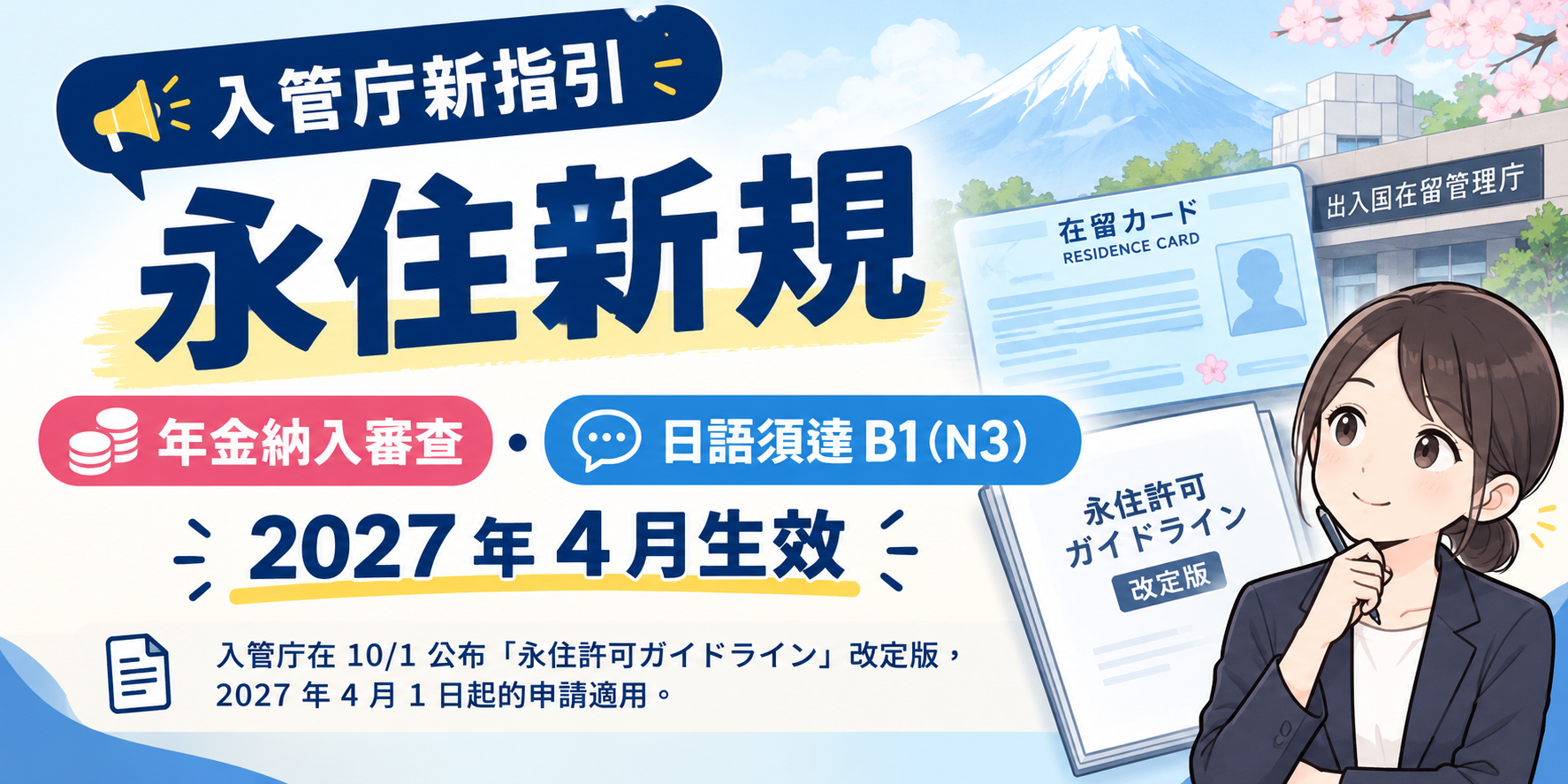
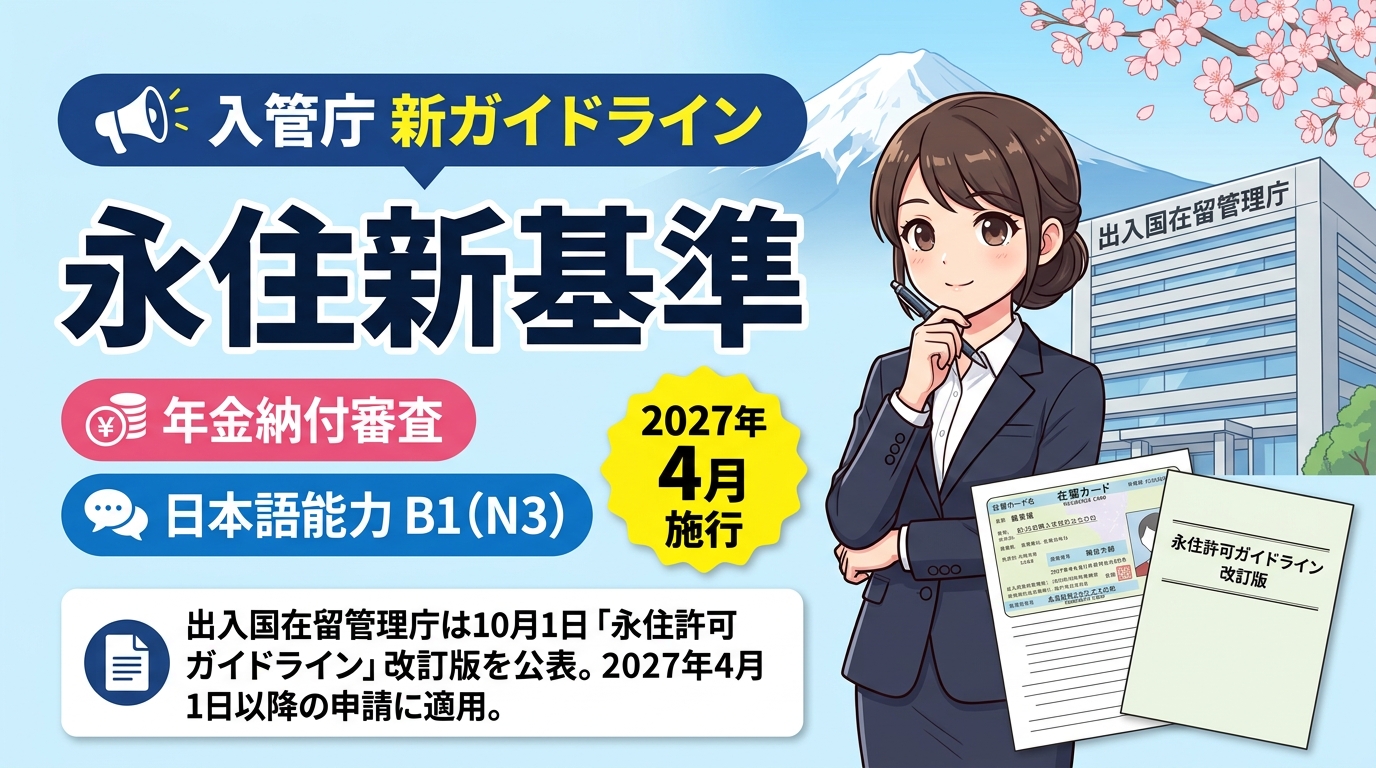
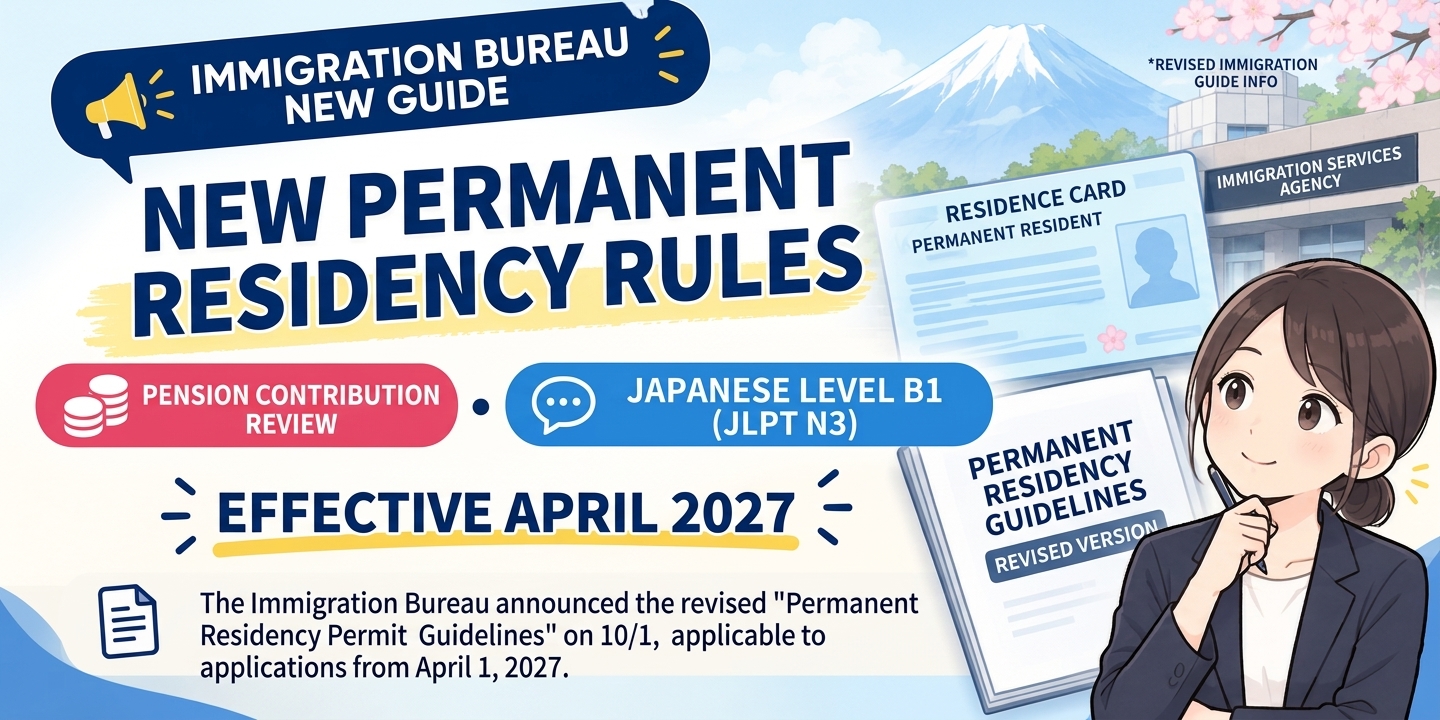
Japan’s Immigration Services Agency (ISA) announced a revised “Permanent Residency Permit Guidelines” on October 1, 2026. The new guidelines apply to permanent residency applications submitted on or after April 1, 2027. The revision covers income, pension contributions, tax compliance, Japanese language ability, and spousal exceptions, with the overall review standard becoming noticeably stricter.
Below, an administrative scrivener (gyoseishoshi) summarizes the key changes so prospective applicants can prepare in advance.
New standards apply to applications filed from April 1, 2027
The revised guidelines are not retroactive — they apply only to applications submitted on or after April 1, 2027. Applicants who do not yet meet the new standards still have time to prepare item by item.
Income Requirement: Household Income Must Exceed the Japanese National Average
Under the new guidelines, the annual income of the “same-livelihood household” must exceed the average income of a Japanese household of the same size.
- Income earned by family members on non-working statuses such as “Dependent” cannot be combined into the household total
- Dependents, including those living overseas, must be counted in the household size
The larger the household, the higher the required average income threshold. Please refer to official Immigration Services Agency announcements for exact figures.
Pension Requirement: New Review Against the Japanese Average Contribution Level
Compared against “30 years of Employees’ Pension contributions at average Japanese income”
Under the new guidelines, an applicant’s pension contribution record will be compared against the benchmark of “30 years of Employees’ Pension Insurance (kosei nenkin) contributions at the average Japanese income level.” Any shortfall can be offset by financial assets, and the threshold is lower for younger applicants.
Tax and Public Dues, Compliance Obligations, and Criminal Record
The new guidelines also strengthen scrutiny of tax payment history, compliance with legal obligations, and criminal records.
- Any past delinquency in taxes, health insurance, or pension contributions will count against the applicant and is reviewed at the household level
- Past violations of legal obligations such as residence registration or carrying one’s residence card are, in principle, treated as negative factors
- A prior sentence of imprisonment or a fine is, in principle, treated as a negative factor
New Japanese Language Requirement: B1 (JLPT N3) or Above
The new guidelines introduce a Japanese language requirement. Applicants must, in principle, demonstrate B1-level Japanese ability, roughly equivalent to JLPT N3 with a score of 104 or above.
Spouse of a Japanese National or Permanent Resident: Higher Residency Thresholds
Spouses of Japanese nationals or permanent residents previously qualified for more relaxed special conditions. The new guidelines raise this threshold as well.
Pre-Application Checklist
- Confirmed whether your household’s annual income meets the Japanese average for the corresponding household size
- Confirmed that dependents, including those overseas, are counted in the household size
- Confirmed your pension contribution status and whether financial assets are needed to supplement it
- Confirmed whether there is any history of delinquent tax, health insurance, or pension payments
- Confirmed whether there is any record of violating residence registration or residence card requirements
- Confirmed whether your Japanese ability reaches B1 (JLPT N3, 104+ points), or whether you qualify for an exemption
- For spouse applicants: confirmed whether you meet the new threshold (5 years married + 3 years of residence)
Frequently Asked Questions (FAQ)
Do the new guidelines apply retroactively to applications already submitted?
No. The new guidelines, in principle, apply only to permanent residency applications submitted on or after April 1, 2027. Applications accepted before that date will be reviewed under the previous standards.
If my pension contributions fall short, does that automatically disqualify me?
Not necessarily. The new guidelines allow financial assets to supplement a pension shortfall, and the required threshold is relatively lower for younger applicants. It is best to assess your specific situation individually.
Does the Japanese language requirement apply to all applicants?
No. Highly Skilled Professionals and their families, as well as those who completed 6 or more years of elementary/secondary education in Japan, are generally exempt from the language requirement.
Is the new spousal threshold already in effect?
It also applies to applications submitted on or after April 1, 2027. Spouse applicants who do not yet meet 5 years of marriage or 3 years of residence should take note of the effective date and plan ahead.
Unsure How the New Guidelines Affect You? Consult Early for Peace of Mind
The revised permanent residency guidelines involve multiple changes across income, pension, tax, Japanese language, and spousal conditions, and how each applies can vary by individual circumstance. If you are unsure whether you meet the new standards, we recommend consulting a professional early to plan your application timeline and prepare the required documents.