- Grounds for Revocation of Permanent Resident Status
- Introduction
- What Is Revocation of Permanent Residence? (Overview of the System)
- When Does the Revocation System Start? Effective Date and Background to the Amendment
- Grounds on Which Permanent Residence May Be Revoked
- What Happens If a Ground for Revocation Applies? (From Investigation to Disposition)
- Cases Not Subject to Revocation (Unavoidable Circumstances)
- What Happens to Family Members’ Status of Residence If Permanent Residence Is Revoked?
- What Can Permanent Residents Do to Prepare Now?
- Frequently Asked Questions (FAQ)
- Q: Will my permanent residence be revoked if I forget to pay a tax bill just once?
- Q: If my permanent residence is revoked, will I necessarily have to return to my home country?
- Q: When will the new grounds for revocation apply? What happens to unpaid amounts from before the effective date?
- Q: If I become a naturalized Japanese citizen, will I no longer have to worry about revocation?
- Q: What should I do if I receive a notice of revocation?
- Conclusion
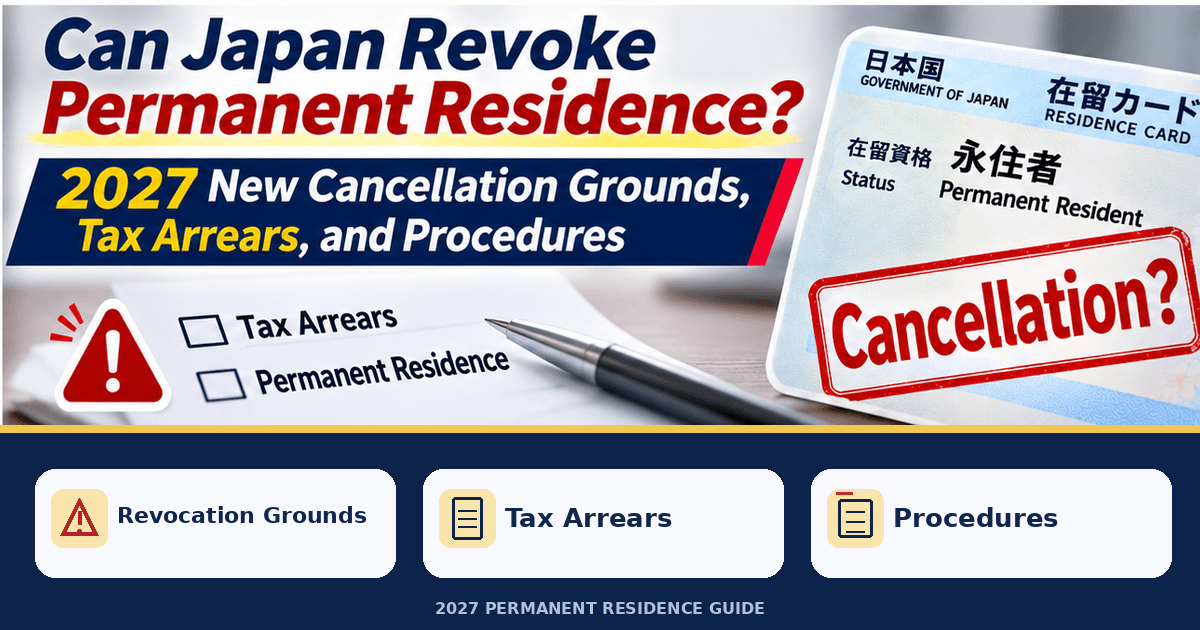
Grounds for Revocation of Permanent Resident Status
Introduction
“Once I obtain permanent residence, I will no longer have to worry about my status of residence.”
Many permanent residents have probably thought this way.
However, an amendment to the Immigration Control Act enacted in 2024 introduced new grounds for revoking the status of residence of permanent residents, and these provisions will take effect on April 1, 2027.
Information such as “Your permanent residence will be revoked if you fall behind on your taxes” has also spread, leaving quite a few people feeling anxious.
Based on information published by the Immigration Services Agency of Japan (hereinafter, the “ISA”), this article explains the system in an accessible way from four perspectives: the grounds for revocation, the effective date, the procedure following revocation, and circumstances that are not subject to revocation.
For convenience, this article uses the term “permanent residence” to refer to the status of residence “Permanent Resident.”
The legal name of the disposition is the revocation of the status of residence “Permanent Resident.”
Special Permanent Residents (persons holding status under the Act on Special Provisions concerning Immigration Control of, Inter Alia, Those Who Have Lost Japanese Nationality on the Basis of the Treaty of Peace with Japan) are not covered by this amendment.
What Is Revocation of Permanent Residence? (Overview of the System)
Revocation of permanent residence means that a person who has been granted the status of residence “Permanent Resident” may have that status revoked if certain circumstances arise after permission has been granted.
Let us first review the overall system.
A common misconception is that the revocation system was established for the first time in 2024.
In fact, permanent residents have long been subject to the system for revoking status of residence.
Even under current law, the status of residence “Permanent Resident” may be revoked for reasons such as failing to notify the authorities of a new residential address, reporting a false residential address, or obtaining permanent residence permission by improper means.
What the 2024 amendment newly introduced was not the revocation system itself, but primarily the following two changes:
- Additional grounds for revocation (including intentional failure to pay public taxes and charges, and sentences of imprisonment for certain serious crimes).
- A new “system for changing status of residence ex officio,” under which a person’s status may be changed to another status instead of being revoked.
(Reference: Immigration Services Agency, Q&A on the Proper Administration of the Permanent Residence Permission System, “Will a person’s status of residence necessarily be revoked if a newly established ground for revocation applies?”)
The status of residence “Permanent Resident” (commonly called permanent residence) places no restrictions on the activities a person may undertake or the period for which they may reside in Japan, and allows them to live a stable life there.
On the other hand, permanent residents are no longer subject to examinations for extensions of their period of stay after permission has been granted. Consequently, even if they cease to meet the conditions that applied when permission was granted, there was previously no mechanism for dealing with matters such as nonpayment of public taxes and charges.
New grounds for revocation were therefore established to address certain particularly serious cases in which a person’s residence circumstances cannot be considered satisfactory.
This amendment also has an aspect of “clarification.”
It expressly sets out in law what is meant by the permanent residence requirement of “being in the interests of Japan,” including properly fulfilling public obligations. The ISA states that this does not introduce new requirements or make existing requirements more stringent.
The requirements for the status of residence “Permanent Resident” itself and the application procedure for permanent residence permission are explained in detail in another article.
Related article: What Is the Status of Residence “Permanent Resident”? | A Simple Guide to Applying for Permanent Residence
When Does the Revocation System Start? Effective Date and Background to the Amendment
When the new grounds for revocation will apply is likely to be one of the most pressing concerns.
The effective date has already been confirmed.
This system forms part of the “proper administration of the permanent residence permission system” under the amended Immigration Control Act (Act No. 60 of 2024, including provisions establishing the Employment for Skill Development System), which was enacted on June 14, 2024 (Reiwa 6), and promulgated on June 21 of the same year.
The effective date was set as April 1, 2027 (Reiwa 9), by a Cabinet Order promulgated on October 1, 2025 (Reiwa 7; Cabinet Order No. 340 of 2025).
Accordingly, the new grounds for revocation explained in this article will apply from April 1, 2027.
(Source: Immigration Services Agency; Cabinet Order No. 340 of 2025)
Grounds on Which Permanent Residence May Be Revoked
The following section explains the new grounds for revocation that take effect on April 1, 2027.
The amended Immigration Control Act adds grounds for revocation that can be organized into three categories.
Categories ① and ② fall under Article 22-4, paragraph (1), item (viii) of the amended Act, while category ③ falls under item (ix) of the same paragraph.
Each is intended to address situations regarded as “malicious” or particularly serious.
① Intentionally Failing to Pay Public Taxes and Charges (Taxes, Social Insurance Premiums, etc.) (Item viii)
The possibility of losing permanent residence because of unpaid taxes or social insurance premiums is what worries the largest number of people.
The important point is that “intentional failure to pay” is required.
“Public taxes and charges” include taxes such as resident tax and income tax, as well as social insurance premiums such as National Health Insurance and pension premiums.
According to the ISA, “intentionally failing to pay public taxes and charges” is intended to cover situations in which a person recognizes that they are obliged to pay and has the financial ability to do so, but deliberately chooses not to pay.
Therefore, forgetting to make a payment once or being temporarily late is not considered to lead immediately to revocation.
② Failure to Comply with Obligations under the Immigration Control Act (Item viii)
The second category is failure to comply with various obligations imposed under the Immigration Control Act.
Like ①, this is included in item (viii).
The ISA explains that this provision concerns failures, without legitimate reason, to fulfill certain obligations imposed on permanent residents under the Act. These are obligations that do not themselves constitute grounds for deportation but whose observance is enforced by penal provisions.
People who ordinarily complete the required procedures are not the intended targets.
For example, the ISA has expressly stated that it does not envisage revoking permanent resident status merely because someone inadvertently failed to carry their residence card or forgot to apply to renew the card’s period of validity.
③ Violations of Certain Serious Criminal Laws (Item ix)
The third category applies where a person commits certain serious crimes and is sentenced to imprisonment.
This falls under item (ix), and the crimes covered are limited.
According to the ISA’s Q&A, the intended offenses are limited to certain serious criminal law violations, such as theft, fraud, extortion, and murder under the Penal Code, and dangerous driving causing death or injury. All involve intentional offenses.
Accordingly, negligent offenses such as negligent driving causing death or injury, Road Traffic Act violations, and cases resulting only in a fine are not covered by this ground for revocation.
It should also be noted that even under current law, a permanent resident who is sentenced to an actual term of imprisonment exceeding one year, for example, may be subject to deportation regardless of the name of the offense.
(Source: Immigration Services Agency, “Q&A on the Proper Administration of the Permanent Residence Permission System”)
What Happens If a Ground for Revocation Applies? (From Investigation to Disposition)
Many people worry, “If my permanent residence is revoked, will I immediately be deported?” However, meeting a ground for revocation does not mean that a person will immediately be required to leave Japan.
According to the ISA, the actual procedure is generally as follows:
- Investigation of the facts.
- Hearing of opinions (an opportunity for the person concerned or their representative to express views and submit evidence).
- Determination of whether a ground for revocation applies.
- If it does apply, a decision either to revoke the status of residence “Permanent Resident” or to change the person’s status ex officio to a status other than Permanent Resident (in many cases, “Long-Term Resident”).
An important point is that an ex officio change of status and revocation are not consecutive steps in one process. They are separate dispositions, and one or the other is selected.
The ISA explains that, except where continued residence is considered inappropriate (for instance, where it is clear that the person has no intention of paying public taxes and charges in the future), a change to “Long-Term Resident” or another status will be considered in many cases.
On the other hand, if the status of residence “Permanent Resident” is actually revoked, a period for preparation for departure, not exceeding 30 days, will generally be designated, and the person will be required to leave within that period.
Failure to leave during the designated period may result in the person becoming subject to deportation.
A person who objects to an ex officio change of status or a revocation disposition may file a lawsuit seeking revocation of the disposition or take other legal action.
Because litigation of this kind and responses to deportation proceedings fall within the professional scope of attorneys, anyone experiencing difficulties after receiving such a disposition should consider consulting an attorney.
A person whose status has been changed to “Long-Term Resident” or another status may also reapply for, and obtain, permanent residence permission if it can subsequently be confirmed that they are properly fulfilling their public obligations and other relevant requirements.
Cases Not Subject to Revocation (Unavoidable Circumstances)
Regarding the issue that causes the most anxiety—unpaid taxes—the ISA has indicated that the system will be administered with restraint.
The following are circumstances in which revocation is not envisaged.
According to the ISA’s Q&A, revocation is not contemplated where a person was unavoidably unable to pay public taxes and charges because of illness, unemployment, or other circumstances that cannot reasonably be attributed to the person’s own fault.
The system is directed at malicious cases involving “intentional” nonpayment.
Even where a ground for revocation applies, the decision whether actually to revoke or change the status will be made in light of individual circumstances, including why the nonpayment occurred and how the person responded to payment demands or reminders.
Whether the arrears were subsequently settled will also be taken into account.
Furthermore, Article 25 of the Supplementary Provisions of the amending Act states that, when making determinations concerning nonpayment of public taxes and charges and similar matters (the part relating to item (viii)), sufficient consideration must be given to the person’s previous payment history, current living circumstances, and other circumstances in which they find themselves.
The system will be applied cautiously, based on a comprehensive assessment of matters such as the person’s ties to Japanese society and actual living conditions.
However, this does not mean that “it is acceptable to leave taxes unpaid.”
Calculating individual tax liabilities and making tax-related judgments fall within the professional scope of licensed tax accountants, while social insurance procedures fall within that of certified social insurance and labor consultants. Please consult the appropriate professional about your specific situation.
What Happens to Family Members’ Status of Residence If Permanent Residence Is Revoked?
Because many people are concerned about the impact not only on themselves but also on their family members, this section explains how family members’ statuses of residence are handled.
According to the ISA, only the individual to whom a ground for revocation applies can be subject to revocation or a change of status.
Family members’ statuses are not revoked or changed merely because of their family relationship to that person.
For example, if a child holds the status of residence “Permanent Resident” or “Spouse or Child of Permanent Resident,” that status will not be affected.
The same applies when a spouse holds the status of residence “Permanent Resident.”
However, if the spouse holds the status of residence “Spouse or Child of Permanent Resident,” that spouse will need to change to “Long-Term Resident” or another status of residence.
(Source: Immigration Services Agency, “Q&A on the Proper Administration of the Permanent Residence Permission System”)
What Can Permanent Residents Do to Prepare Now?
The provisions will take effect on April 1, 2027.
There is no need to worry excessively, but it is reassuring to check whether you have properly fulfilled your public obligations before the system takes effect.
First, check the payment status of resident tax, income tax, National Health Insurance premiums, pension premiums, and other public charges.
If any amounts remain unpaid or overdue, it is advisable to resolve them as soon as possible.
If you cannot pay immediately, you may be able to obtain information about options such as installment payments by consulting your local government tax payment office or a pension office.
It is important not to leave the matter unattended, but to seek advice.
The ISA also advises people having difficulty paying public taxes and charges to consult the relevant authorities, and states that merely visiting an office to discuss payment is not, in itself, envisaged as a reason for reporting the person.
Those with concerns about their status of residence may also consult a counter at the Foreign Residents Support Center (FRESC).
Specific calculations of tax amounts and decisions concerning tax savings fall within the professional scope of licensed tax accountants; anyone with complex circumstances is advised to consult one.
Frequently Asked Questions (FAQ)
Below are answers to frequently asked questions about revocation of permanent residence.
Q: Will my permanent residence be revoked if I forget to pay a tax bill just once?
Because “intentional failure to pay” is required, an accidental missed payment or temporary delay is considered unlikely to lead immediately to revocation.
However, caution is needed if someone has the ability to pay but continues leaving payments outstanding for a prolonged period.
We recommend paying promptly or seeking advice as soon as you become aware of the problem.
Q: If my permanent residence is revoked, will I necessarily have to return to my home country?
Meeting a ground for revocation alone does not necessarily mean that you must return to your home country.
After an investigation and a hearing of opinions, an ex officio change to “Long-Term Resident” or another status is considered in many cases.
However, if the status of residence “Permanent Resident” is actually revoked, you must, in principle, leave Japan within the designated period.
Q: When will the new grounds for revocation apply? What happens to unpaid amounts from before the effective date?
The new grounds for revocation take effect on April 1, 2027.
The new grounds take effect on 1 April 2027. Official parliamentary testimony explains that intentional non-payment after PR was granted but before commencement can become a consideration if discovered afterwards and the statutory grounds are met. A pre-commencement circumstance alone does not automatically determine cancellation; subsequent payments and individual circumstances are assessed carefully. The October 2026 guideline further explains intention, arrears, duration, frequency, responses and discretionary status changes.
Q: If I become a naturalized Japanese citizen, will I no longer have to worry about revocation?
A person who acquires Japanese nationality through naturalization is no longer subject to the status-of-residence system itself.
However, naturalization has its own requirements and examination procedures, and it is a different system from permanent residence.
Which is more suitable depends on individual circumstances.
Related article: What Is Naturalization? Differences from Permanent Residence, Requirements, and Procedure
Q: What should I do if I receive a notice of revocation?
You will be given an opportunity to have your views heard, during which you may state your position and submit evidence.
If you have unavoidable circumstances, it is important to explain them.
Because deadlines may apply to the procedure, we recommend consulting a professional promptly after receiving a notice.
Conclusion
The key points concerning revocation of permanent residence (the new grounds for revocation) are as follows:
- Permanent residents have long been subject to the system for revoking status of residence. The 2024 amendment to the Immigration Control Act (Act No. 60 of 2024) added new grounds for revocation and a system for changing status of residence ex officio.
- The effective date of the new grounds for revocation has been confirmed as April 1, 2027, by Cabinet Order (Cabinet Order No. 340 of 2025).
- Grounds for revocation comprise ① intentional nonpayment of public taxes and charges (item viii), ② failure to comply with obligations under the Immigration Control Act (item viii), and ③ a sentence of imprisonment for a serious crime (item ix).
- The requirements focus on “intentional and malicious” conduct; unpaid amounts arising from unavoidable circumstances such as illness or unemployment are not envisaged as grounds for revocation.
- Even if a ground for revocation applies, the person does not immediately have to return home. In principle, an ex officio change to “Long-Term Resident” or another status will be considered (revocation and change of status are separate, mutually exclusive dispositions). If status is actually revoked, a departure period is designated.
- A family member’s status of residence will not be revoked solely because of the family relationship.
- Useful preparations now include checking whether public obligations have been paid and resolving outstanding amounts promptly.
For individual cases, we recommend consulting a professional.
This article is based on immigration laws and regulations and publicly available information as of June 2026. Its contents may change as a result of legal amendments or other developments. For the latest information, please check the official website of the Immigration Services Agency and other official sources. For individual cases, we recommend consulting professionals such as attorneys or administrative scriveners.
Need guidance on your own situation?
Requirements and supporting documents depend on individual circumstances. Contact Akatsuki Immigration Office to discuss your case.
ISA:永住者の在留資格の取消しに関するガイドライン(2026年10月1日) / 國會會議錄:2024年6月6日・發言123
Visa Worries? Let's Talk Now.
070-8971-0608